
A New Dividing Line for Work
My working life now has two eras, before Claude Code and after. The gap is wide enough that the first one already feels like another century.
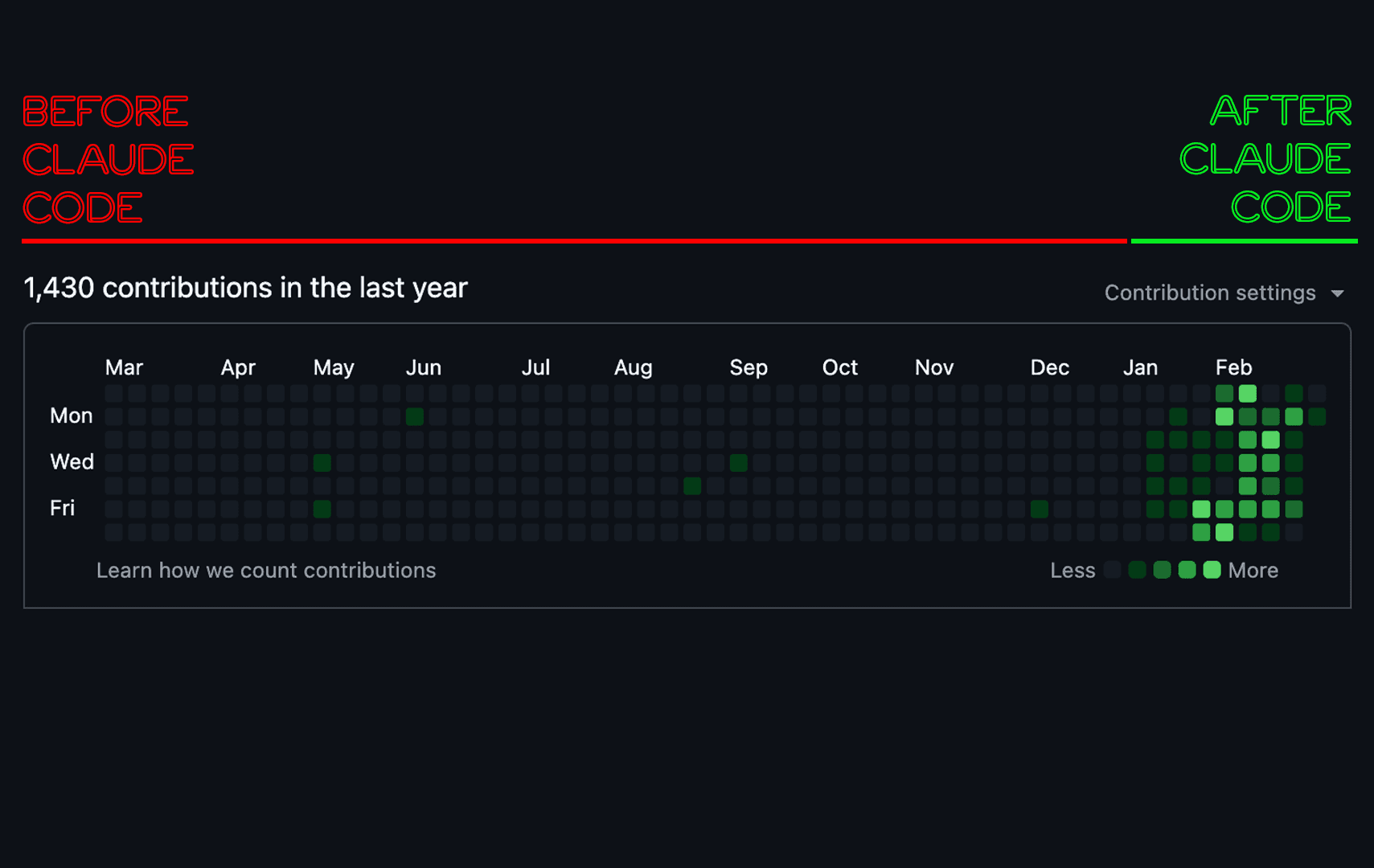
History has its dividing lines. Moments so significant that everything gets measured against them. Before and after.
For me, that line is Claude Code.
I'm not being dramatic. I'm being precise. My working life now has two eras: BCC (Before Claude Code) and ACC (After Claude Code). And the gap between them is so wide that BCC already feels like a different century.
The World Before
BCC wasn't bad. I was productive. I ran workshops, built strategies, delivered for clients. I used AI tools — ChatGPT, Copilot, the usual suspects. I thought I was ahead of the curve.
I was using AI the way most people still do: as a slightly better search engine. Ask a question, get an answer, copy-paste something useful. Maybe generate a first draft that needed heavy editing. It felt like progress at the time.
But here's what I didn't realise: I was still doing all the heavy lifting. The thinking, the structuring, the connecting of dots, the building — that was all me, with AI occasionally handing me a brick.
The Moment Everything Changed
Claude Code didn't just hand me bricks. It started building alongside me.
The first time I used it properly — not as a chatbot, but as a genuine collaborator — something shifted. I wasn't asking it questions anymore. I was working with it. Planning. Iterating. Building things I wouldn't have attempted alone. Not because I couldn't, but because the time and effort would have made it impractical.
This is the bit that's hard to explain to people who haven't experienced it: Claude Code doesn't just do tasks faster. It changes what you consider possible in a working day.
Projects that would have taken weeks now take days. Ideas that would have stayed in a notebook because "who has the time?" actually get built. The gap between thinking something and shipping it has collapsed.
What ACC Actually Looks Like
Let me be specific, because vague AI hype is everywhere and it helps no one.
My knowledge base is alive. I have an entire repository — my "brain" — that Claude Code reads, writes to, and builds on. It knows my clients, my brand, my voice, my frameworks. Every session picks up where the last one left off. It's not a tool I use. It's a collaborator that knows my work.
I build things I couldn't before. Not because I've suddenly learned to code. Because the barrier between "I want this to exist" and "this exists" has almost disappeared. Want a workshop framework? A content strategy? A client proposal structure? The thinking is mine. The building is ours.
Quality goes up, not just speed. This is the counterintuitive bit. You'd think working faster means cutting corners. The opposite happens. Because the grunt work takes less time, I spend more time on the thinking. More time on whether something is actually good. More time on the bits that matter.
I'm braver. When building something only costs time, you play it safe. When you have a collaborator that can help you prototype in minutes, you try things. Weird ideas. Ambitious ideas. The kind of ideas that die in notebooks when you're working alone.
Why Anthropic, Though?
I should be clear: this isn't a paid endorsement. Nobody asked me to write this. I'm writing it because I genuinely believe Anthropic is building something different.
It's not just the product — though the product is remarkable. It's the philosophy behind it. The transparency. The thoughtfulness about safety. The way they think about AI as a collaborator rather than a replacement. The way Claude feels to work with — like it actually cares about getting things right, not just getting things done.
Every interaction I have with Claude reinforces something: this company understands that the future of AI isn't about replacing humans. It's about making humans more capable. More creative. More ambitious.
Three recent things that cemented it for me:
1. The Super Bowl ads. Anthropic's first ever TV campaign was bold, funny, and brilliantly crafted — showing what happens when AI conversations get hijacked by ads. Creative that actually says something. Rare in tech.
2. The no-ads pledge. While competitors rush to monetise your conversations with sponsored links, Anthropic publicly committed to keeping Claude ad-free. Your conversations stay yours. That takes conviction.
3. Boris Cherny on Lenny's Podcast. The head of Claude Code sat down to talk about what happens after coding is solved. No hype, no hand-waving — just a builder explaining what they're actually building and why. Refreshing.
That's exactly what Jointly believes about collaboration. The best work doesn't happen when one party does everything. It happens when different capabilities — human and AI — come together.
This Is the Me+AI Era
At Jointly, we talk about three modes of collaboration: Me+AI, Me+Us, and Us+AI. Claude Code is the most powerful expression of Me+AI I've ever experienced.
It's not artificial intelligence pretending to be human. It's artificial intelligence being genuinely, usefully intelligent — in a way that amplifies what I can do rather than replacing what I am.
And here's what excites me most: we're at the very beginning of ACC. This is the earliest this technology will ever be. If it's this transformative now, what does it look like in a year? In five?
What This Means for You
If you're still in the BCC era — still using AI as a fancy search engine, still doing all the building yourself, still keeping ambitious ideas in notebooks — I get it. I was there. The jump feels big.
But here's the thing: the gap between BCC and ACC isn't closing. It's widening. Every day.
You don't have to go all-in overnight. Start small. Pick one project. Work with AI rather than just using it. See what happens when the barrier between thinking and building disappears.
Because once you've experienced ACC, you can't go back. And honestly? You won't want to.
This article was unashamedly written jointly with AI. Obviously. Because that's the whole point.