Read all about it folks
Our Blog
Our Blog
Our Blog
This is where we think out loud. About collaboration,
innovation, marketing and the tools and tech that
help teams do their best thinking together.
This is where we think out loud. About collaboration,
innovation, marketing and the tools and tech that
help teams do their best thinking together.
This is where we think out loud. About collaboration, innovation, marketing
and the tools and tech that help teams do their best thinking together.
Our Opinions
3 February 2026
Posted By: Jonny Lang
McKinsey is cutting 10% of its workforce. The firm that tells everyone else how to restructure is restructuring itself.
AI is automating the very work consultants built their model on. The gathering of data, synthesising research, building slide decks and generating first drafts.
That last one matters most.
The first draft used to be expensive as it took time, training and proper graft to get anything onto the page. Now you can generate ten versions of almost anything before your coffee gets cold.
This doesn’t mean creation got easier. It means the bottleneck moved and the hard work now sits at both ends.
Upstream: deciding what’s actually worth making, who it’s for and why it matters.
Downstream: knowing whether what comes back is any good, fixing what counts and standing behind the result.
The draft in the middle? That’s the easy part now.
AI writes. We edit. That’s the new division of labour.
Mind you, “editing” doesn’t mean what most people think it means.
⸻
Above the Line, Below the Line
In book publishing there’s a distinction between what editors do below the line and above the line.
Below the line is what most people imagine, grammar, clarity, consistency, polish, application of red pen, tutting etc.
Above the line is everything else, Should this exist at all? – What is it really trying to say? – What’s missing? – Who is this actually for? – When is it done?
Peter Ginna, editor of What Editors Do, describes the role as being a connector, a conduit between writer and reader, a translator or someone who improves communication in both directions.
That’s not someone fixing commas, it’s someone standing between creation and audience asking one hard question:
Does this work?
Jonathan Karp, now CEO of Simon & Schuster, puts it more bluntly. Editors earn their keep at the acquisitions stage. Choosing what to bet on. “No amount of brilliant editing can turn an unsaleable book into a winner.”
The skill isn’t polish. It’s judgement about what deserves to be polished in the first place.
⸻
What McKinsey Is Really Cutting
When McKinsey talks about its AI strategy, it’s explicit about what stays and what goes.
They’ll keep hiring people who face clients and they’ll shrink the layers that gather, synthesise and present information.
Production work is being automated where judgement, relationships and accountability are being protected.
In other words, the people who decide what to make and whether it worked.
Editors.
This isn’t about one firm or one industry. As one analysis of the cuts put it, “the premium for future talent will no longer rest on analytical horsepower alone.”
The old moat, being good at processing information has drained away.
What’s valuable now is knowing what the information means, whether it matters and what to do about it.
⸻
“Editor” Is Not the Grammar Police
When people hear “editor,” they think red pen.
That’s not the job.
The real job is taste, judgement, and accountability. The ability to say this works or this is nonsense and live with the consequences.
These skills were always valuable. They were just harder to see when we were busy typing.
Publishing figured this out years ago. Editors were never content producers. Manuscripts arrived in huge volumes, most of them unusable. The job was selection, shaping and saying no far more often than yes.
That’s now everyone’s job – The lawyer reviewing AI-drafted contracts – The strategist sifting AI-generated scenarios – The marketer choosing between AI-produced campaigns – The leader deciding which insight to back and which to bin.
The cost of production has collapsed and the value of selection has gone through the roof.
⸻
The Skill That Was Hiding in Plain Sight
For decades, consulting and knowledge work ran on a comforting assumption that the hard part was doing the work. Analysis. Research. Synthesis. Presentation.
Clients paid for output.
AI exposes what was always true, the output was never the point as the real value was knowing what question to ask, recognising the right answer when you saw it and having the nerve to act on it.
Clearly those aren’t analytical skills, they’re editorial ones.
⸻
What Editing Looks Like at Work Now
This is the part most people miss.
Modern editing isn’t about fixing text. It’s about shaping thinking.
The editing moves that matter now:
Framing: “What problem are we actually solving here?”
Audience editing:“Who is this really for and what will they care about?”
Insight extraction: “Which trend or data point matters and which is just noise?
Assumption testing: “What would have to be true for this to work?”
Selection: “If we could only keep one idea, which survives?” –
Stopping: “This is good enough. We’re done.”
These show up as prompts too: For example, “What’s the strongest version of this argument and why might it still be wrong?” – “What would a sceptic say in one sentence?” – “What’s missing that would change the decision?” – “If this failed in six months, what would we say we ignored?” – “Which part is trying too hard?”
AI is very good at generating options. It is terrible at choosing.
That’s on us.
⸻
Start Now
At the end of last year we watched a leadership team use AI to generate five versions of a strategy in about ten minutes. Perfectly coherent, nicely structured, all of them very plausible.
Then they sat looking at each other as nobody could say which one was right, or whether any of them were. The AI had done the writing but it couldn’t tell them what they actually believed.
That’s the gap and it’s not going away, so it’s time to train your editorial instinct.
Read more and notice why things work or fall flat. Practice explaining what you’d cut, not just what you’d add. Get comfortable making calls with incomplete information because that’s all you ever have.
Most importantly, get used to being accountable for decisions AI helped you make but won’t help you defend.
The machines can write. But they can’t decide what’s worth writing, or whether it’s good enough. They can’t take responsibility when it matters.
That work has a name. It's called editing. And it's not going anywhere.
Next time: We built a thing. It's a boardroom full of opinionated execs who'll tell you what's wrong with your idea. Except they don't exist, they won’t judge and they're available at 11pm on a Sunday. We'll show you how it works.".
What We’re Reading
Three pieces this week that all circle the same uncomfortable question: in a world where AI can produce anything, who decides what’s actually worth making? The answers point the same direction, toward judgment, discernment and the stubbornly human skill of knowing when to say no:
The Rise of Taste: Why Human Curation Will Define the AI Era — Debris Studio “Taste is a responsibility. It’s not just about what you like. It’s about what you allow in.” A design studio argues that in a world drowning in AI-generated content, the scarcest skill isn’t creation, it’s the wisdom to know what’s worth creating in the first place.
Velocity Is the New Authority. Here’s Why — Om Malik Authority used to be the organising principle of information. You earned attention by being right. That world is gone. Now the algorithm doesn’t care whether something is true, it cares whether it moves. The result: a culture optimised for first takes, not best takes.
AI Is Everywhere. Editors Should Be, Too — Poynter A catalogue of AI-generated disasters from fake books, to fabricated sources, to hallucinated facts, all with one thing in common: no editor in sight.
Here's a question that's been nagging at us lately.
What if we've got the whole prompting thing backwards?
The AI conversation has become obsessed with prompts writing and "engineering". How to phrase your request or how to structure your instructions, Basically, how to coax better outputs from the black box. It's undoubtedly a useful and important skill, but one that's over egged as the answer to being able to say "I'm good at AI".
Unsurprisingly it was in a workshop, with real people working live on real problems, that we began to experiment with something much more interesting.
The magic happens when AI prompts you.
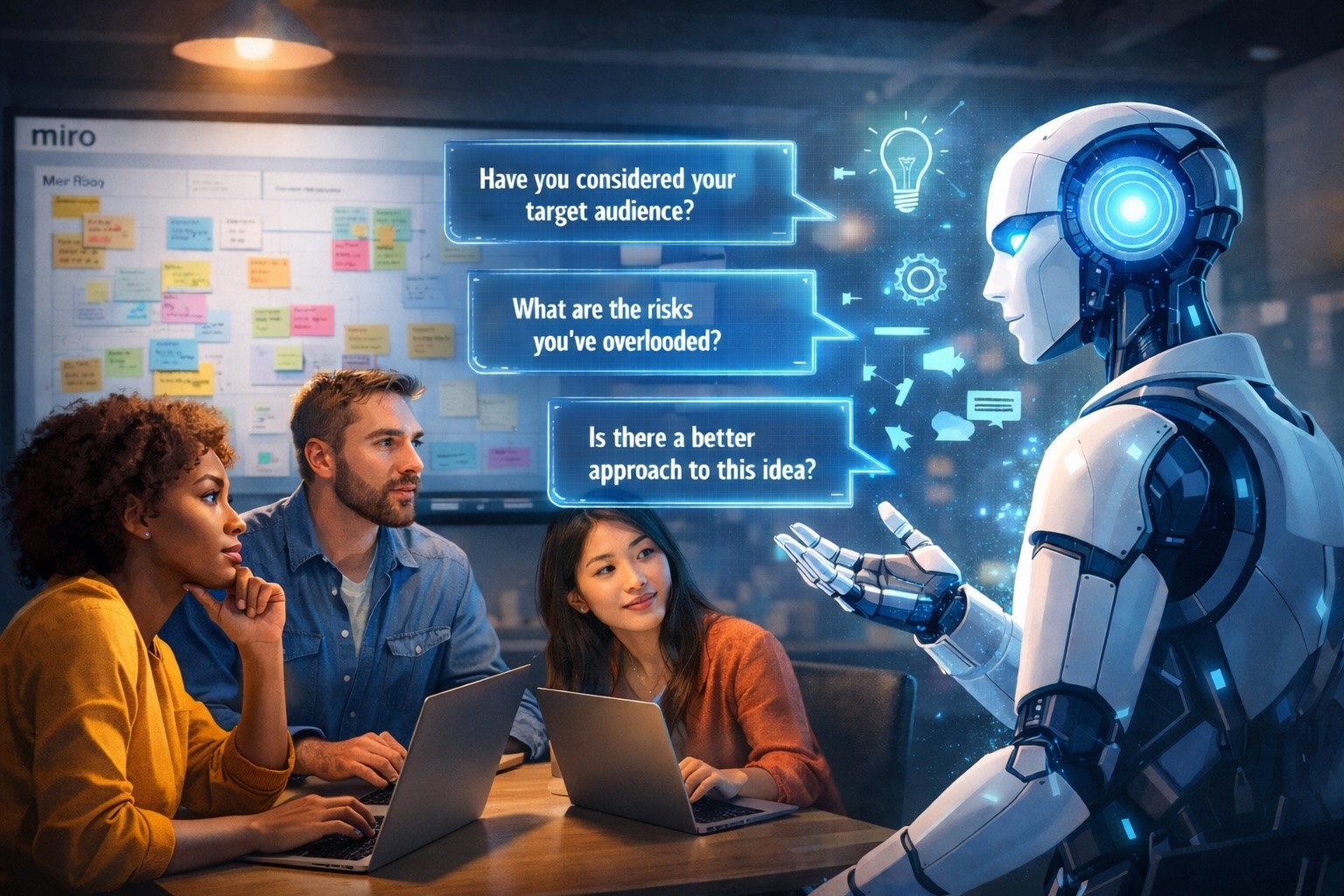
We'd been messing about with Miro's new AI capability, specifically what they call "Sidekicks" in our workshops. We made a shift that's subtle but ended up being significant. Instead of teams asking AI to generate ideas or summarise and document what they'd done, we started configuring Sidekicks to do something different and challenge the team back.
Picture this. A team is mapping out their product strategy. They've been at it for ninety minutes and they're getting comfortable with their assumptions. Then the Sidekick drops a question:
"You've mentioned 'customer experience' twelve times but haven't defined which customers you mean. Who specifically are you designing for and who have you decided to exclude?"
To begin with we get silence and nervous "how did we miss that" laughter. Then, the actual conversation begins and the AI challenge to the group works its magic.
This isn't how most people think about AI in collaboration. The default mode is AI-as-assistant. You give it a task, twiddle your thumbs while it does its thing, get an output. All very fast, efficient and pretty scalable at a personal level. But in a room full of people trying to solve a strategic problem, speed isn't the bottleneck, clarity and confidence are. The willingness to say the thing everyone's been dancing around.
And this is where an AI challenger becomes surprisingly useful.
A Miro AI Sidekick doesn't care about hierarchy. It won't soften its question because the boss is in the room. It has no career anxiety. It reads the Miro board as context, gets what's really going on or spots the glaring omission and asks the uncomfortable thing. Maybe it's the thing a junior team member might notice but would never say out loud, or something we miss while facilitating because they're we're focused on maintaining focus and keeping energy high.
Researchers at Carnegie Mellon have been exploring this exact dynamic, understanding how AI might serve in "partnership or facilitation roles rather than managerial ones." They describe AI as a tool that can provide the user with an alternative perspective. That's exactly what we're seeing. Not AI doing the thinking. AI provoking better thinking.
There's a reason this works particularly well in workshops.
When you're brainstorming alone with ChatGPT, the dynamic is simple. You prompt, it responds, you iterate, you share. But when you're in a room (or on a Miro board, or both) with a dozen other people, the social dynamics get complicated. Who speaks first? Who dominates? Who holds back? Now, our workshops go a long way to limiting this, nevertheless too often, the loudest voice often wins, not because their idea is best but because volume is a proxy for confidence.
AI can disrupt this in a useful way. When AI poses a question based on what the group have written on their stickies, not what someone said loudest, it creates a moment of democratic reckoning. Everyone has to engage with the same provocation and it pushes the collective to more and better ideas.
Being prompted" changes our role too.
Normally, a good facilitator reads the room, notices when things have gone off the boil and thinking is getting stale. They intervene with a question or activity to break the pattern and create progress. That skill still matters. But now you can configure an AI teammate to do some of that pattern-recognition work in real time. We can focus on human dynamics. The AI watches the content.
A piece from The Living Core, a German consultancy puts it nicely. Rather than letting AI do our work, we can create loops where AI prompts deeper exploration of our own ideas. They describe it as "positively disruptive prompting" or AI triggering thoughts we wouldn't have had otherwise.
That's the crux of it all. From AI as answer machine to AI as thinking partner. From prompting it to being prompted by it.
We're still in the early days of figuring this out, even the Miro AI Sidekicks are still in beta and the configurations that work best are still emerging. But we've seen enough to believe this is a meaningful direction.
In a world obsessed with AI outputs, the teams that will thrive are the ones who use AI to improve their inputs, the quality of their questions, the depth of their exploration, the honesty of their conversations.
Stop asking what AI can do for you. Start asking what AI can ask of you.
Next time: We'll look at an old role that's suddenly become essential, the editor. And why the skills it requires are important as they're hard to automate but harder to define than you'd think.
Here's a question that's been nagging at us lately.
What if we've got the whole prompting thing backwards?
The AI conversation has become obsessed with prompts writing and "engineering". How to phrase your request or how to structure your instructions, Basically, how to coax better outputs from the black box. It's undoubtedly a useful and important skill, but one that's over egged as the answer to being able to say "I'm good at AI".
Unsurprisingly it was in a workshop, with real people working live on real problems, that we began to experiment with something much more interesting.
The magic happens when AI prompts you.
We'd been messing about with Miro's new AI capability, specifically what they call "Sidekicks" in our workshops. We made a shift that's subtle but ended up being significant. Instead of teams asking AI to generate ideas or summarise and document what they'd done, we started configuring Sidekicks to do something different and challenge the team back.
Picture this. A team is mapping out their product strategy. They've been at it for ninety minutes and they're getting comfortable with their assumptions. Then the Sidekick drops a question:
"You've mentioned 'customer experience' twelve times but haven't defined which customers you mean. Who specifically are you designing for and who have you decided to exclude?"
To begin with we get silence and nervous "how did we miss that" laughter. Then, the actual conversation begins and the AI challenge to the group works its magic.
This isn't how most people think about AI in collaboration. The default mode is AI-as-assistant. You give it a task, twiddle your thumbs while it does its thing, get an output. All very fast, efficient and pretty scalable at a personal level. But in a room full of people trying to solve a strategic problem, speed isn't the bottleneck, clarity and confidence are. The willingness to say the thing everyone's been dancing around.
And this is where an AI challenger becomes surprisingly useful.
A Miro AI Sidekick doesn't care about hierarchy. It won't soften its question because the boss is in the room. It has no career anxiety. It reads the Miro board as context, gets what's really going on or spots the glaring omission and asks the uncomfortable thing. Maybe it's the thing a junior team member might notice but would never say out loud, or something we miss while facilitating because they're we're focused on maintaining focus and keeping energy high.
Researchers at Carnegie Mellon have been exploring this exact dynamic, understanding how AI might serve in "partnership or facilitation roles rather than managerial ones." They describe AI as a tool that can provide the user with an alternative perspective. That's exactly what we're seeing. Not AI doing the thinking. AI provoking better thinking.
There's a reason this works particularly well in workshops.
When you're brainstorming alone with ChatGPT, the dynamic is simple. You prompt, it responds, you iterate, you share. But when you're in a room (or on a Miro board, or both) with a dozen other people, the social dynamics get complicated. Who speaks first? Who dominates? Who holds back? Now, our workshops go a long way to limiting this, nevertheless too often, the loudest voice often wins, not because their idea is best but because volume is a proxy for confidence.
AI can disrupt this in a useful way. When AI poses a question based on what the group have written on their stickies, not what someone said loudest, it creates a moment of democratic reckoning. Everyone has to engage with the same provocation and it pushes the collective to more and better ideas.
Being prompted" changes our role too.
Normally, a good facilitator reads the room, notices when things have gone off the boil and thinking is getting stale. They intervene with a question or activity to break the pattern and create progress. That skill still matters. But now you can configure an AI teammate to do some of that pattern-recognition work in real time. We can focus on human dynamics. The AI watches the content.
A piece from The Living Core, a German consultancy puts it nicely. Rather than letting AI do our work, we can create loops where AI prompts deeper exploration of our own ideas. They describe it as "positively disruptive prompting" or AI triggering thoughts we wouldn't have had otherwise.
That's the crux of it all. From AI as answer machine to AI as thinking partner. From prompting it to being prompted by it.
We're still in the early days of figuring this out, even the Miro AI Sidekicks are still in beta and the configurations that work best are still emerging. But we've seen enough to believe this is a meaningful direction.
In a world obsessed with AI outputs, the teams that will thrive are the ones who use AI to improve their inputs, the quality of their questions, the depth of their exploration, the honesty of their conversations.
Stop asking what AI can do for you. Start asking what AI can ask of you.
Next time: We'll look at an old role that's suddenly become essential, the editor. And why the skills it requires are important as they're hard to automate but harder to define than you'd think.
Here's a question that's been nagging at us lately.
What if we've got the whole prompting thing backwards?
The AI conversation has become obsessed with prompts writing and "engineering". How to phrase your request or how to structure your instructions, Basically, how to coax better outputs from the black box. It's undoubtedly a useful and important skill, but one that's over egged as the answer to being able to say "I'm good at AI".
Unsurprisingly it was in a workshop, with real people working live on real problems, that we began to experiment with something much more interesting.
The magic happens when AI prompts you.
We'd been messing about with Miro's new AI capability, specifically what they call "Sidekicks" in our workshops. We made a shift that's subtle but ended up being significant. Instead of teams asking AI to generate ideas or summarise and document what they'd done, we started configuring Sidekicks to do something different and challenge the team back.
Picture this. A team is mapping out their product strategy. They've been at it for ninety minutes and they're getting comfortable with their assumptions. Then the Sidekick drops a question:
"You've mentioned 'customer experience' twelve times but haven't defined which customers you mean. Who specifically are you designing for and who have you decided to exclude?"
To begin with we get silence and nervous "how did we miss that" laughter. Then, the actual conversation begins and the AI challenge to the group works its magic.
This isn't how most people think about AI in collaboration. The default mode is AI-as-assistant. You give it a task, twiddle your thumbs while it does its thing, get an output. All very fast, efficient and pretty scalable at a personal level. But in a room full of people trying to solve a strategic problem, speed isn't the bottleneck, clarity and confidence are. The willingness to say the thing everyone's been dancing around.
And this is where an AI challenger becomes surprisingly useful.
A Miro AI Sidekick doesn't care about hierarchy. It won't soften its question because the boss is in the room. It has no career anxiety. It reads the Miro board as context, gets what's really going on or spots the glaring omission and asks the uncomfortable thing. Maybe it's the thing a junior team member might notice but would never say out loud, or something we miss while facilitating because they're we're focused on maintaining focus and keeping energy high.
Researchers at Carnegie Mellon have been exploring this exact dynamic, understanding how AI might serve in "partnership or facilitation roles rather than managerial ones." They describe AI as a tool that can provide the user with an alternative perspective. That's exactly what we're seeing. Not AI doing the thinking. AI provoking better thinking.
There's a reason this works particularly well in workshops.
When you're brainstorming alone with ChatGPT, the dynamic is simple. You prompt, it responds, you iterate, you share. But when you're in a room (or on a Miro board, or both) with a dozen other people, the social dynamics get complicated. Who speaks first? Who dominates? Who holds back? Now, our workshops go a long way to limiting this, nevertheless too often, the loudest voice often wins, not because their idea is best but because volume is a proxy for confidence.
AI can disrupt this in a useful way. When AI poses a question based on what the group have written on their stickies, not what someone said loudest, it creates a moment of democratic reckoning. Everyone has to engage with the same provocation and it pushes the collective to more and better ideas.
Being prompted" changes our role too.
Normally, a good facilitator reads the room, notices when things have gone off the boil and thinking is getting stale. They intervene with a question or activity to break the pattern and create progress. That skill still matters. But now you can configure an AI teammate to do some of that pattern-recognition work in real time. We can focus on human dynamics. The AI watches the content.
A piece from The Living Core, a German consultancy puts it nicely. Rather than letting AI do our work, we can create loops where AI prompts deeper exploration of our own ideas. They describe it as "positively disruptive prompting" or AI triggering thoughts we wouldn't have had otherwise.
That's the crux of it all. From AI as answer machine to AI as thinking partner. From prompting it to being prompted by it.
We're still in the early days of figuring this out, even the Miro AI Sidekicks are still in beta and the configurations that work best are still emerging. But we've seen enough to believe this is a meaningful direction.
In a world obsessed with AI outputs, the teams that will thrive are the ones who use AI to improve their inputs, the quality of their questions, the depth of their exploration, the honesty of their conversations.
Stop asking what AI can do for you. Start asking what AI can ask of you.
Next time: We'll look at an old role that's suddenly become essential, the editor. And why the skills it requires are important as they're hard to automate but harder to define than you'd think.
A new framework for collaboration in the AI era
Here’s a question no one’s asking clearly enough. What what actually happens to collaboration when AI shows up?
Not “how do I use ChatGPT better.” Not “will AI take my job.” The harder question. “When humans and machines start thinking together, what does good teamwork actually look like anymore?”.
We’ve spent the past year watching this play out. Working with teams, running workshops, watching what happens when AI gets dropped into existing ways of working. And we’ve come to believe that most organisations are solving the wrong problem.The conversation has been stuck on individual productivity. How do I get better at prompting? How do I save time? But the interesting challenge isn’t at an individual level, it’s what’s happening between people.
Here’s the pattern we keep seeing. AI doesn’t fix broken collaboration. It makes it worse. It amplifies the problems.
The loudest voice in the room used to dominate meetings. Now they dominate meetings and fire off polished looking documents before the rest of us have had time to think at all. Bad assumptions spread quicker. The same team dysfunctions that have always existed are now running at machine speed and with better formatting.
So what do most organisations do? They train people harder. More prompt workshops. More tool tutorials. More people getting clever with AI on their own.
Twenty people who are each good with AI doesn’t give you a team that’s good with AI. It gives you twenty separate experiments, twenty different approaches and confusion about which outputs to trust.
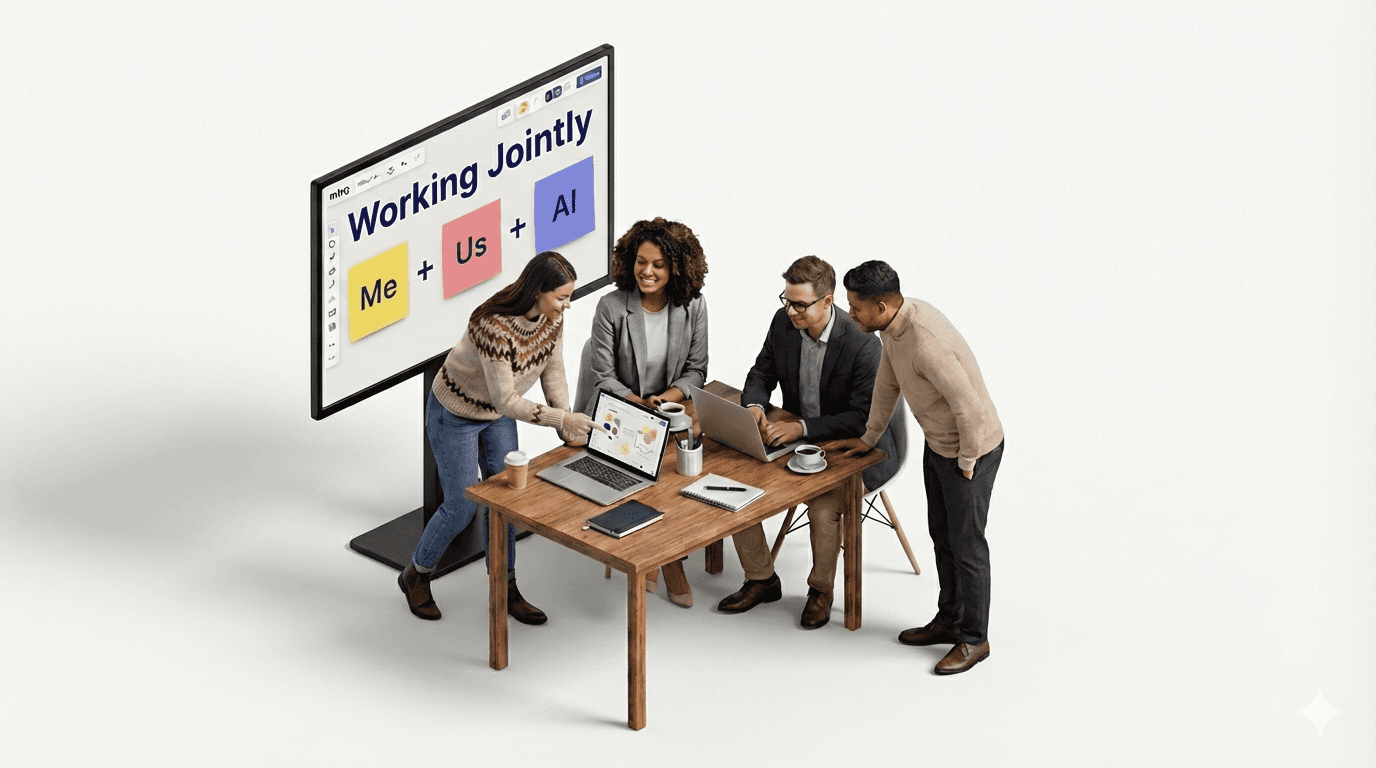
We’re proposing a framework that we’re calling Working Jointly. Not because we have all the answers, but because we need a name for the thing we’re trying to figure out. Three dimensions of joint work that we believe need to develop together. It goes something like this:
Me + AI
How I think, decide, and create alongside AI.
This is where all the attention goes, and fair enough, it’s where everyone has to start. Individual fluency with AI tools. You need individual fluency before anything else makes sense. You need to know when the thing is lying to you, when it’s useful, when it’s just making you lazy.
We should be honest here. This dimension has changed how we work. There are only a few of us. AI has let us operate like a company three times our size, creating, researching, prototyping at a pace that wasn’t possible before. We’ve learned a lot about what works, what doesn’t and where the traps are. It’s time we started sharing that.
Me + Us
How we collaborate better as humans.
This is home turf for us. It’s where Jointly started, years before anyone was talking about ChatGPT. We’ve spent a long time helping teams actually think together, using Miro, designing workshops, trying to create the conditions where a room full of smart people produces something smarter than any of them would alone. It’s harder than it looks. Most meetings fail at it.
Here’s what gets overlooked in the AI conversation. The human skills that matter more, not less, as AI handles more of the execution. How do we disagree productively? Make decisions under uncertainty? Hold each other accountable? Build trust?Teams with the strongest human collaboration will use AI best. This dimension is often the first casualty in the rush to adopt new tools. We think that’s a mistake.
Us + AI
How teams use AI collectively, not individually.
This is where almost no one is yet. Shared prompts. Shared workflows. Shared practices. Intelligence that compounds across a team over time, not just within individual heads.
Everyone is training individuals. Almost no one is building organisational AI capability. That gap—between individual fluency and collective intelligence—is where we think the real opportunity lives.
AI amplifies existing dynamics. If your collaboration is weak, AI makes it weaker. If it's strong, AI becomes an accelerant.
The argument we're making is this:
The organisations that get this right won’t treat Me, Us, and AI as three separate problems, an AI training initiative here, a culture programme there, some team-building off to the side. They’ll see them as three dimensions of the same thing. A way of working where AI amplifies what teams can do together, and where the human collaboration actually gets better rather than being hollowed out.
What comes next
We're going to work through this, in public. What we’re learning, what we’re getting wrong, what we’re stealing from people smarter than us. We’ll share the practices that seem to help and the experiments that fell flat. There’s no playbook for this yet. We’re writing it as we go, and we’d rather do that out loud than pretend we’ve got it figured out.
A new framework for collaboration in the AI era
Here’s a question no one’s asking clearly enough. What what actually happens to collaboration when AI shows up?
Not “how do I use ChatGPT better.” Not “will AI take my job.” The harder question. “When humans and machines start thinking together, what does good teamwork actually look like anymore?”.
We’ve spent the past year watching this play out. Working with teams, running workshops, watching what happens when AI gets dropped into existing ways of working. And we’ve come to believe that most organisations are solving the wrong problem.The conversation has been stuck on individual productivity. How do I get better at prompting? How do I save time? But the interesting challenge isn’t at an individual level, it’s what’s happening between people.
Here’s the pattern we keep seeing. AI doesn’t fix broken collaboration. It makes it worse. It amplifies the problems.
The loudest voice in the room used to dominate meetings. Now they dominate meetings and fire off polished looking documents before the rest of us have had time to think at all. Bad assumptions spread quicker. The same team dysfunctions that have always existed are now running at machine speed and with better formatting.
So what do most organisations do? They train people harder. More prompt workshops. More tool tutorials. More people getting clever with AI on their own.
Twenty people who are each good with AI doesn’t give you a team that’s good with AI. It gives you twenty separate experiments, twenty different approaches and confusion about which outputs to trust.
We’re proposing a framework that we’re calling Working Jointly. Not because we have all the answers, but because we need a name for the thing we’re trying to figure out. Three dimensions of joint work that we believe need to develop together. It goes something like this:
Me + AI
How I think, decide, and create alongside AI.
This is where all the attention goes, and fair enough, it’s where everyone has to start. Individual fluency with AI tools. You need individual fluency before anything else makes sense. You need to know when the thing is lying to you, when it’s useful, when it’s just making you lazy.
We should be honest here. This dimension has changed how we work. There are only a few of us. AI has let us operate like a company three times our size, creating, researching, prototyping at a pace that wasn’t possible before. We’ve learned a lot about what works, what doesn’t and where the traps are. It’s time we started sharing that.
Me + Us
How we collaborate better as humans.
This is home turf for us. It’s where Jointly started, years before anyone was talking about ChatGPT. We’ve spent a long time helping teams actually think together, using Miro, designing workshops, trying to create the conditions where a room full of smart people produces something smarter than any of them would alone. It’s harder than it looks. Most meetings fail at it.
Here’s what gets overlooked in the AI conversation. The human skills that matter more, not less, as AI handles more of the execution. How do we disagree productively? Make decisions under uncertainty? Hold each other accountable? Build trust?Teams with the strongest human collaboration will use AI best. This dimension is often the first casualty in the rush to adopt new tools. We think that’s a mistake.
Us + AI
How teams use AI collectively, not individually.
This is where almost no one is yet. Shared prompts. Shared workflows. Shared practices. Intelligence that compounds across a team over time, not just within individual heads.
Everyone is training individuals. Almost no one is building organisational AI capability. That gap—between individual fluency and collective intelligence—is where we think the real opportunity lives.
AI amplifies existing dynamics. If your collaboration is weak, AI makes it weaker. If it's strong, AI becomes an accelerant.
The argument we're making is this:
The organisations that get this right won’t treat Me, Us, and AI as three separate problems, an AI training initiative here, a culture programme there, some team-building off to the side. They’ll see them as three dimensions of the same thing. A way of working where AI amplifies what teams can do together, and where the human collaboration actually gets better rather than being hollowed out.
What comes next
We're going to work through this, in public. What we’re learning, what we’re getting wrong, what we’re stealing from people smarter than us. We’ll share the practices that seem to help and the experiments that fell flat. There’s no playbook for this yet. We’re writing it as we go, and we’d rather do that out loud than pretend we’ve got it figured out.
A new framework for collaboration in the AI era
Here’s a question no one’s asking clearly enough. What what actually happens to collaboration when AI shows up?
Not “how do I use ChatGPT better.” Not “will AI take my job.” The harder question. “When humans and machines start thinking together, what does good teamwork actually look like anymore?”.
We’ve spent the past year watching this play out. Working with teams, running workshops, watching what happens when AI gets dropped into existing ways of working. And we’ve come to believe that most organisations are solving the wrong problem.The conversation has been stuck on individual productivity. How do I get better at prompting? How do I save time? But the interesting challenge isn’t at an individual level, it’s what’s happening between people.
Here’s the pattern we keep seeing. AI doesn’t fix broken collaboration. It makes it worse. It amplifies the problems.
The loudest voice in the room used to dominate meetings. Now they dominate meetings and fire off polished looking documents before the rest of us have had time to think at all. Bad assumptions spread quicker. The same team dysfunctions that have always existed are now running at machine speed and with better formatting.
So what do most organisations do? They train people harder. More prompt workshops. More tool tutorials. More people getting clever with AI on their own.
Twenty people who are each good with AI doesn’t give you a team that’s good with AI. It gives you twenty separate experiments, twenty different approaches and confusion about which outputs to trust.
We’re proposing a framework that we’re calling Working Jointly. Not because we have all the answers, but because we need a name for the thing we’re trying to figure out. Three dimensions of joint work that we believe need to develop together. It goes something like this:
Me + AI
How I think, decide, and create alongside AI.
This is where all the attention goes, and fair enough, it’s where everyone has to start. Individual fluency with AI tools. You need individual fluency before anything else makes sense. You need to know when the thing is lying to you, when it’s useful, when it’s just making you lazy.
We should be honest here. This dimension has changed how we work. There are only a few of us. AI has let us operate like a company three times our size, creating, researching, prototyping at a pace that wasn’t possible before. We’ve learned a lot about what works, what doesn’t and where the traps are. It’s time we started sharing that.
Me + Us
How we collaborate better as humans.
This is home turf for us. It’s where Jointly started, years before anyone was talking about ChatGPT. We’ve spent a long time helping teams actually think together, using Miro, designing workshops, trying to create the conditions where a room full of smart people produces something smarter than any of them would alone. It’s harder than it looks. Most meetings fail at it.
Here’s what gets overlooked in the AI conversation. The human skills that matter more, not less, as AI handles more of the execution. How do we disagree productively? Make decisions under uncertainty? Hold each other accountable? Build trust?Teams with the strongest human collaboration will use AI best. This dimension is often the first casualty in the rush to adopt new tools. We think that’s a mistake.
Us + AI
How teams use AI collectively, not individually.
This is where almost no one is yet. Shared prompts. Shared workflows. Shared practices. Intelligence that compounds across a team over time, not just within individual heads.
Everyone is training individuals. Almost no one is building organisational AI capability. That gap—between individual fluency and collective intelligence—is where we think the real opportunity lives.
AI amplifies existing dynamics. If your collaboration is weak, AI makes it weaker. If it's strong, AI becomes an accelerant.
The argument we're making is this:
The organisations that get this right won’t treat Me, Us, and AI as three separate problems, an AI training initiative here, a culture programme there, some team-building off to the side. They’ll see them as three dimensions of the same thing. A way of working where AI amplifies what teams can do together, and where the human collaboration actually gets better rather than being hollowed out.
What comes next
We're going to work through this, in public. What we’re learning, what we’re getting wrong, what we’re stealing from people smarter than us. We’ll share the practices that seem to help and the experiments that fell flat. There’s no playbook for this yet. We’re writing it as we go, and we’d rather do that out loud than pretend we’ve got it figured out.
How often have you heard this? A big company maying McKinsey millions for some kind of "transformation" strategy. Big words. Big invoice. Three months later it’s in a drawer. Not because it was necessarily wrong. Because it was obvious. Their own people had been saying the same thing for years. They just hadn't been heard. So they'd paid someone in a designer gilet to say it louder.
And you know what? This isn't unusual at all.
Every day, companies pay fortunes for external validation of internal knowledge. They hire strangers to tell them what their own people have been screaming into the void. It's corporate theatre at its most expensive.
Now, it's easy to take a swing McKinsey (they did tell us all to back the Metaverse, remember?). They make a convenient villain. But the same thing happens with any big consultancy or marketing agency promising to crack your problem at great expense. The pattern is identical: throw the problem over the wall to an outsider, wait for the deck, then wonder why nothing changes.
Here's what nobody wants to say out loud. Outsourcing your thinking is a way of cheating on your team. The signal it sends is brutal. Either you don't trust the answers they've already given you, or worse, you don't believe they have answers worth hearing in the first place. Either way, you've just told your people that a stranger's opinion matters more than theirs.
The expertise problem
Here's what McKinsey won't tell you: your team already knows what needs to be done. They've been living with your problems, watching your customers, fighting your battles every single day. They don't need frameworks. They need permission.
According to our research across 200+ sprints, internal teams identify the right solution 85% of the time. The issue isn't knowledge. It's confidence. It's the political cover to say what everyone's thinking but no one's saying.
The real issue isn't intellectual. It's behavioural. As Peter Drucker wrote decades ago, "Culture eats strategy for breakfast." And your culture is eating your team's best ideas before they even reach the boardroom.
The collaboration fix
So what's the fix?
The solution isn't another consultant. It's actual collaboration. Not "alignment." Not "buy-in." Actual work, together.
Most teams don't need someone to hand them the answer. But they do need help drawing it out of themselves. The knowledge is there, it's just stuck. Buried under hierarchy, habit and the fear of saying the obvious thing out loud.
That's what we do. We run proper collaboration sessions, on Miro, with real structure that brings everyone together and draw those answers out. No months of interviews. No waiting for a massive deck. Just the right people, the right questions and the right space for it all to come together.
Making space for truth
Workshops work because they bypass the hierarchy that kills honesty. They create what psychologists call "psychological safety" - the confidence to speak without career consequences.
Here, the intern can challenge the CEO's assumption. The engineer can question the marketing strategy. The quiet thinker gets the same airtime as the confident speaker.
It's not magic. It's method. And it's exactly what your team needs to beat any consultancy at their own game.
Why it beats McKinsey
It takes a fraction of the time. A fraction of the money. And when it's done, the team owns the outcome. They built it. They believe it. They have skin in the game.
Your people are better than your procurement habits suggest. Every consultancy contract is a vote of no confidence whether you mean it that way or not.
The brains are already on payroll. The experience is already in the building. What's missing isn't capability it's the conditions to use it.
So before you brief another agency, ask a harder question. When did you last give your team the space, the tools and the permission to solve this themselves?
You might find they've been ready for a while. They were just waiting to be asked.
Don't bring in outsiders. Bring people together.
How often have you heard this? A big company maying McKinsey millions for some kind of "transformation" strategy. Big words. Big invoice. Three months later it’s in a drawer. Not because it was necessarily wrong. Because it was obvious. Their own people had been saying the same thing for years. They just hadn't been heard. So they'd paid someone in a designer gilet to say it louder.
And you know what? This isn't unusual at all.
Every day, companies pay fortunes for external validation of internal knowledge. They hire strangers to tell them what their own people have been screaming into the void. It's corporate theatre at its most expensive.
Now, it's easy to take a swing McKinsey (they did tell us all to back the Metaverse, remember?). They make a convenient villain. But the same thing happens with any big consultancy or marketing agency promising to crack your problem at great expense. The pattern is identical: throw the problem over the wall to an outsider, wait for the deck, then wonder why nothing changes.
Here's what nobody wants to say out loud. Outsourcing your thinking is a way of cheating on your team. The signal it sends is brutal. Either you don't trust the answers they've already given you, or worse, you don't believe they have answers worth hearing in the first place. Either way, you've just told your people that a stranger's opinion matters more than theirs.
The expertise problem
Here's what McKinsey won't tell you: your team already knows what needs to be done. They've been living with your problems, watching your customers, fighting your battles every single day. They don't need frameworks. They need permission.
According to our research across 200+ sprints, internal teams identify the right solution 85% of the time. The issue isn't knowledge. It's confidence. It's the political cover to say what everyone's thinking but no one's saying.
The real issue isn't intellectual. It's behavioural. As Peter Drucker wrote decades ago, "Culture eats strategy for breakfast." And your culture is eating your team's best ideas before they even reach the boardroom.
The collaboration fix
So what's the fix?
The solution isn't another consultant. It's actual collaboration. Not "alignment." Not "buy-in." Actual work, together.
Most teams don't need someone to hand them the answer. But they do need help drawing it out of themselves. The knowledge is there, it's just stuck. Buried under hierarchy, habit and the fear of saying the obvious thing out loud.
That's what we do. We run proper collaboration sessions, on Miro, with real structure that brings everyone together and draw those answers out. No months of interviews. No waiting for a massive deck. Just the right people, the right questions and the right space for it all to come together.
Making space for truth
Workshops work because they bypass the hierarchy that kills honesty. They create what psychologists call "psychological safety" - the confidence to speak without career consequences.
Here, the intern can challenge the CEO's assumption. The engineer can question the marketing strategy. The quiet thinker gets the same airtime as the confident speaker.
It's not magic. It's method. And it's exactly what your team needs to beat any consultancy at their own game.
Why it beats McKinsey
It takes a fraction of the time. A fraction of the money. And when it's done, the team owns the outcome. They built it. They believe it. They have skin in the game.
Your people are better than your procurement habits suggest. Every consultancy contract is a vote of no confidence whether you mean it that way or not.
The brains are already on payroll. The experience is already in the building. What's missing isn't capability it's the conditions to use it.
So before you brief another agency, ask a harder question. When did you last give your team the space, the tools and the permission to solve this themselves?
You might find they've been ready for a while. They were just waiting to be asked.
Don't bring in outsiders. Bring people together.
How often have you heard this? A big company maying McKinsey millions for some kind of "transformation" strategy. Big words. Big invoice. Three months later it’s in a drawer. Not because it was necessarily wrong. Because it was obvious. Their own people had been saying the same thing for years. They just hadn't been heard. So they'd paid someone in a designer gilet to say it louder.
And you know what? This isn't unusual at all.
Every day, companies pay fortunes for external validation of internal knowledge. They hire strangers to tell them what their own people have been screaming into the void. It's corporate theatre at its most expensive.
Now, it's easy to take a swing McKinsey (they did tell us all to back the Metaverse, remember?). They make a convenient villain. But the same thing happens with any big consultancy or marketing agency promising to crack your problem at great expense. The pattern is identical: throw the problem over the wall to an outsider, wait for the deck, then wonder why nothing changes.
Here's what nobody wants to say out loud. Outsourcing your thinking is a way of cheating on your team. The signal it sends is brutal. Either you don't trust the answers they've already given you, or worse, you don't believe they have answers worth hearing in the first place. Either way, you've just told your people that a stranger's opinion matters more than theirs.
The expertise problem
Here's what McKinsey won't tell you: your team already knows what needs to be done. They've been living with your problems, watching your customers, fighting your battles every single day. They don't need frameworks. They need permission.
According to our research across 200+ sprints, internal teams identify the right solution 85% of the time. The issue isn't knowledge. It's confidence. It's the political cover to say what everyone's thinking but no one's saying.
The real issue isn't intellectual. It's behavioural. As Peter Drucker wrote decades ago, "Culture eats strategy for breakfast." And your culture is eating your team's best ideas before they even reach the boardroom.
The collaboration fix
So what's the fix?
The solution isn't another consultant. It's actual collaboration. Not "alignment." Not "buy-in." Actual work, together.
Most teams don't need someone to hand them the answer. But they do need help drawing it out of themselves. The knowledge is there, it's just stuck. Buried under hierarchy, habit and the fear of saying the obvious thing out loud.
That's what we do. We run proper collaboration sessions, on Miro, with real structure that brings everyone together and draw those answers out. No months of interviews. No waiting for a massive deck. Just the right people, the right questions and the right space for it all to come together.
Making space for truth
Workshops work because they bypass the hierarchy that kills honesty. They create what psychologists call "psychological safety" - the confidence to speak without career consequences.
Here, the intern can challenge the CEO's assumption. The engineer can question the marketing strategy. The quiet thinker gets the same airtime as the confident speaker.
It's not magic. It's method. And it's exactly what your team needs to beat any consultancy at their own game.
Why it beats McKinsey
It takes a fraction of the time. A fraction of the money. And when it's done, the team owns the outcome. They built it. They believe it. They have skin in the game.
Your people are better than your procurement habits suggest. Every consultancy contract is a vote of no confidence whether you mean it that way or not.
The brains are already on payroll. The experience is already in the building. What's missing isn't capability it's the conditions to use it.
So before you brief another agency, ask a harder question. When did you last give your team the space, the tools and the permission to solve this themselves?
You might find they've been ready for a while. They were just waiting to be asked.
Don't bring in outsiders. Bring people together.
In the rush to embrace AI, we've turned it into the ultimate productivity theatre. Reports materialise in minutes, slide decks assemble themselves, emails arrive perfectly phrased with those telltale Oxford commas. Everything looks professional until someone tries to use it and then the facts don't hold up, the logic dissolves, the ideas collapse under the weight of their own polish.
There's a name for this now. Workslop. The growing flood of AI-generated output that looks like work, sounds like work, but adds nothing of value.
According to researchers at Stanford and BetterUp, it already accounts for around 15% of work in most organisations (we think it's much more than that), costing time, money and trust as businesses begin drown in nonsense.
The real issue isn't technological, it's behavioural. As Cassie Kozyrkov wrote in Harvard Business Review, workslop is "thoughtlessness enabled by AI". When we can skip the hardest part of work, the actual thinking, our instincts tell us to do exactly that. And when everyone's doing it, we get thoughtlessness at scale.
Good friction
AI has quietly stripped away something we didn't realise we needed - friction. The conversations, the disagreements, the questioning. All the messy (and frankly enjoyable) human stuff that forced us to make sense before we spoke.
Without it, we just get cognitive pollution. Why? Because we've treated AI like a vending machine for answers instead of a tool for better thinking.
So what's the fix?
Not another layer of software. An older, simpler idea, proper collaboration. The workshop.
Workshops have always been places where people slow down to think together to question, debate and connect ideas until they actually make sense. Now, with AI-enabled workshops on platforms like Miro we can have the best of both worlds.
Quiet correction
Workslop happens when organisations confuse output with outcome. When they chase more instead of better.
But the companies that thrive in the age of AI won't be the ones generating the most words. They'll be the ones generating the most sense.
The workshop is a key component of how we get there. A space where AI makes it easier to start the conversation, not finish it.
That's exactly what we're building at Jointly.
A place where teams use AI not to avoid the hard work of thinking, but to think better, together. More workshop. Less workslop.
In the rush to embrace AI, we've turned it into the ultimate productivity theatre. Reports materialise in minutes, slide decks assemble themselves, emails arrive perfectly phrased with those telltale Oxford commas. Everything looks professional until someone tries to use it and then the facts don't hold up, the logic dissolves, the ideas collapse under the weight of their own polish.
There's a name for this now. Workslop. The growing flood of AI-generated output that looks like work, sounds like work, but adds nothing of value.
According to researchers at Stanford and BetterUp, it already accounts for around 15% of work in most organisations (we think it's much more than that), costing time, money and trust as businesses begin drown in nonsense.
The real issue isn't technological, it's behavioural. As Cassie Kozyrkov wrote in Harvard Business Review, workslop is "thoughtlessness enabled by AI". When we can skip the hardest part of work, the actual thinking, our instincts tell us to do exactly that. And when everyone's doing it, we get thoughtlessness at scale.
Good friction
AI has quietly stripped away something we didn't realise we needed - friction. The conversations, the disagreements, the questioning. All the messy (and frankly enjoyable) human stuff that forced us to make sense before we spoke.
Without it, we just get cognitive pollution. Why? Because we've treated AI like a vending machine for answers instead of a tool for better thinking.
So what's the fix?
Not another layer of software. An older, simpler idea, proper collaboration. The workshop.
Workshops have always been places where people slow down to think together to question, debate and connect ideas until they actually make sense. Now, with AI-enabled workshops on platforms like Miro we can have the best of both worlds.
Quiet correction
Workslop happens when organisations confuse output with outcome. When they chase more instead of better.
But the companies that thrive in the age of AI won't be the ones generating the most words. They'll be the ones generating the most sense.
The workshop is a key component of how we get there. A space where AI makes it easier to start the conversation, not finish it.
That's exactly what we're building at Jointly.
A place where teams use AI not to avoid the hard work of thinking, but to think better, together. More workshop. Less workslop.
In the rush to embrace AI, we've turned it into the ultimate productivity theatre. Reports materialise in minutes, slide decks assemble themselves, emails arrive perfectly phrased with those telltale Oxford commas. Everything looks professional until someone tries to use it and then the facts don't hold up, the logic dissolves, the ideas collapse under the weight of their own polish.
There's a name for this now. Workslop. The growing flood of AI-generated output that looks like work, sounds like work, but adds nothing of value.
According to researchers at Stanford and BetterUp, it already accounts for around 15% of work in most organisations (we think it's much more than that), costing time, money and trust as businesses begin drown in nonsense.
The real issue isn't technological, it's behavioural. As Cassie Kozyrkov wrote in Harvard Business Review, workslop is "thoughtlessness enabled by AI". When we can skip the hardest part of work, the actual thinking, our instincts tell us to do exactly that. And when everyone's doing it, we get thoughtlessness at scale.
Good friction
AI has quietly stripped away something we didn't realise we needed - friction. The conversations, the disagreements, the questioning. All the messy (and frankly enjoyable) human stuff that forced us to make sense before we spoke.
Without it, we just get cognitive pollution. Why? Because we've treated AI like a vending machine for answers instead of a tool for better thinking.
So what's the fix?
Not another layer of software. An older, simpler idea, proper collaboration. The workshop.
Workshops have always been places where people slow down to think together to question, debate and connect ideas until they actually make sense. Now, with AI-enabled workshops on platforms like Miro we can have the best of both worlds.
Quiet correction
Workslop happens when organisations confuse output with outcome. When they chase more instead of better.
But the companies that thrive in the age of AI won't be the ones generating the most words. They'll be the ones generating the most sense.
The workshop is a key component of how we get there. A space where AI makes it easier to start the conversation, not finish it.
That's exactly what we're building at Jointly.
A place where teams use AI not to avoid the hard work of thinking, but to think better, together. More workshop. Less workslop.
Some tools shout. Some tools show off. Some tools think they’re the star. Miro doesn’t.
It doesn't dominate proceedings. It doesn't try to replace you. It just gives your thinking somewhere to go, somewhere it can be seen. By you. By the team.
Not hidden in slides. Not scattered in Slack. Out in the open.
And that’s what matters. Because it’s the difference between working hard. And actually working together.
The browser for work
A browser isn’t the internet. It’s just how you get there. That’s Miro. It’s not the work. It’s the space that makes the work happen.
A universal canvas where where ideas from different people, different disciplines, different time zones can exist and develop in the same space at the same time.
Every browser knows its job is to get out of the way and let you reach what matters. Miro understands the same thing.
Together Isn’t a Tab
Modern work is lonely. Everyone’s busy. No one’s present.
But in Miro, presence comes back. Not through chaos but through structure that invites contribution not control.
Half-baked ideas? Good. Bring them in. This isn’t about making a mess. It’s about giving thinking room to breathe. And structure to take shape. That’s what real creativity needs.
Miro gives you a stage, not a script. It trusts you to think for yourself.
When a tool gets out of the way, people step up. This is why, for modern teams trying to rebuild connection across offices and time zones, Miro remains peerless. Because it doesn’t fragment. It unites.
Why we picked it
We tried the lot. FigJam, Mural, Zoom Whiteboard, Microsoft Whiteboard—all the usual suspects.
They all sort of worked. Technically.
But Miro felt different. It thinks like we do.We don’t want automation. We want augmentation. Not tools that do the work for us. Tools that give the work a home.
Because when your platform becomes your practice, you need one that was built for working together. Not just working.
Collaborative AI, not solo AI
Most AI is needy. You prompt. It answers. Repeat. You're stuck in a loop of explaining context, trying to extract something useful.
Miro flips this with a simple but profound idea. The canvas is the prompt.
It sees what the team sees. It knows what you’re trying to do.
And it joins in. Not as a robot. As another brain in the room. The kind that nudges. Pushes. Questions. Connects. It’s not about replacing your thinking. It’s about provoking better thinking.
Collaborative AI that makes teams think better, not less.
"AI's biggest opportunity lies in teamwork and accelerating outcomes that teams are driving, not just individual productivity. The canvas is the best surface to bring teams together with AI."
Andrey Khusid, Founder and CEO, Miro
Take Miro's prototyping capabilities. You’ve seen this situation. A really great idea. The team’s excited. Then someone says "great idea, let me take that away and build it" and the collaborative energy dies.
Miro stops that happening. Because the idea never leaves the room. Prototypes get made right there. Live. On the canvas. That’s what the AI’s for. Momentum. Not just answers.
What love looks like
So yes, we love Miro.
Not because it’s flashy. Not because it's clever. Because it’s thoughtful. But because it knows when to be quiet. And when to speak up.
And in a world full of “solutions” that isolate people, Miro brings us together.
It’s not just a tool. It’s a place. A place where thinking lives. Where teams work out loud. Where AI doesn’t take over.
That’s why we use it. That’s why we trust it. That’s why it’s home.
Some tools shout. Some tools show off. Some tools think they’re the star. Miro doesn’t.
It doesn't dominate proceedings. It doesn't try to replace you. It just gives your thinking somewhere to go, somewhere it can be seen. By you. By the team.
Not hidden in slides. Not scattered in Slack. Out in the open.
And that’s what matters. Because it’s the difference between working hard. And actually working together.
The browser for work
A browser isn’t the internet. It’s just how you get there. That’s Miro. It’s not the work. It’s the space that makes the work happen.
A universal canvas where where ideas from different people, different disciplines, different time zones can exist and develop in the same space at the same time.
Every browser knows its job is to get out of the way and let you reach what matters. Miro understands the same thing.
Together Isn’t a Tab
Modern work is lonely. Everyone’s busy. No one’s present.
But in Miro, presence comes back. Not through chaos but through structure that invites contribution not control.
Half-baked ideas? Good. Bring them in. This isn’t about making a mess. It’s about giving thinking room to breathe. And structure to take shape. That’s what real creativity needs.
Miro gives you a stage, not a script. It trusts you to think for yourself.
When a tool gets out of the way, people step up. This is why, for modern teams trying to rebuild connection across offices and time zones, Miro remains peerless. Because it doesn’t fragment. It unites.
Why we picked it
We tried the lot. FigJam, Mural, Zoom Whiteboard, Microsoft Whiteboard—all the usual suspects.
They all sort of worked. Technically.
But Miro felt different. It thinks like we do.We don’t want automation. We want augmentation. Not tools that do the work for us. Tools that give the work a home.
Because when your platform becomes your practice, you need one that was built for working together. Not just working.
Collaborative AI, not solo AI
Most AI is needy. You prompt. It answers. Repeat. You're stuck in a loop of explaining context, trying to extract something useful.
Miro flips this with a simple but profound idea. The canvas is the prompt.
It sees what the team sees. It knows what you’re trying to do.
And it joins in. Not as a robot. As another brain in the room. The kind that nudges. Pushes. Questions. Connects. It’s not about replacing your thinking. It’s about provoking better thinking.
Collaborative AI that makes teams think better, not less.
"AI's biggest opportunity lies in teamwork and accelerating outcomes that teams are driving, not just individual productivity. The canvas is the best surface to bring teams together with AI."
Andrey Khusid, Founder and CEO, Miro
Take Miro's prototyping capabilities. You’ve seen this situation. A really great idea. The team’s excited. Then someone says "great idea, let me take that away and build it" and the collaborative energy dies.
Miro stops that happening. Because the idea never leaves the room. Prototypes get made right there. Live. On the canvas. That’s what the AI’s for. Momentum. Not just answers.
What love looks like
So yes, we love Miro.
Not because it’s flashy. Not because it's clever. Because it’s thoughtful. But because it knows when to be quiet. And when to speak up.
And in a world full of “solutions” that isolate people, Miro brings us together.
It’s not just a tool. It’s a place. A place where thinking lives. Where teams work out loud. Where AI doesn’t take over.
That’s why we use it. That’s why we trust it. That’s why it’s home.
Some tools shout. Some tools show off. Some tools think they’re the star. Miro doesn’t.
It doesn't dominate proceedings. It doesn't try to replace you. It just gives your thinking somewhere to go, somewhere it can be seen. By you. By the team.
Not hidden in slides. Not scattered in Slack. Out in the open.
And that’s what matters. Because it’s the difference between working hard. And actually working together.
The browser for work
A browser isn’t the internet. It’s just how you get there. That’s Miro. It’s not the work. It’s the space that makes the work happen.
A universal canvas where where ideas from different people, different disciplines, different time zones can exist and develop in the same space at the same time.
Every browser knows its job is to get out of the way and let you reach what matters. Miro understands the same thing.
Together Isn’t a Tab
Modern work is lonely. Everyone’s busy. No one’s present.
But in Miro, presence comes back. Not through chaos but through structure that invites contribution not control.
Half-baked ideas? Good. Bring them in. This isn’t about making a mess. It’s about giving thinking room to breathe. And structure to take shape. That’s what real creativity needs.
Miro gives you a stage, not a script. It trusts you to think for yourself.
When a tool gets out of the way, people step up. This is why, for modern teams trying to rebuild connection across offices and time zones, Miro remains peerless. Because it doesn’t fragment. It unites.
Why we picked it
We tried the lot. FigJam, Mural, Zoom Whiteboard, Microsoft Whiteboard—all the usual suspects.
They all sort of worked. Technically.
But Miro felt different. It thinks like we do.We don’t want automation. We want augmentation. Not tools that do the work for us. Tools that give the work a home.
Because when your platform becomes your practice, you need one that was built for working together. Not just working.
Collaborative AI, not solo AI
Most AI is needy. You prompt. It answers. Repeat. You're stuck in a loop of explaining context, trying to extract something useful.
Miro flips this with a simple but profound idea. The canvas is the prompt.
It sees what the team sees. It knows what you’re trying to do.
And it joins in. Not as a robot. As another brain in the room. The kind that nudges. Pushes. Questions. Connects. It’s not about replacing your thinking. It’s about provoking better thinking.
Collaborative AI that makes teams think better, not less.
"AI's biggest opportunity lies in teamwork and accelerating outcomes that teams are driving, not just individual productivity. The canvas is the best surface to bring teams together with AI."
Andrey Khusid, Founder and CEO, Miro
Take Miro's prototyping capabilities. You’ve seen this situation. A really great idea. The team’s excited. Then someone says "great idea, let me take that away and build it" and the collaborative energy dies.
Miro stops that happening. Because the idea never leaves the room. Prototypes get made right there. Live. On the canvas. That’s what the AI’s for. Momentum. Not just answers.
What love looks like
So yes, we love Miro.
Not because it’s flashy. Not because it's clever. Because it’s thoughtful. But because it knows when to be quiet. And when to speak up.
And in a world full of “solutions” that isolate people, Miro brings us together.
It’s not just a tool. It’s a place. A place where thinking lives. Where teams work out loud. Where AI doesn’t take over.
That’s why we use it. That’s why we trust it. That’s why it’s home.