What If AI Prompted You?
Stop asking what AI can do for you. We tried the reverse in a live workshop, and the room got sharper the moment AI started asking the questions.
Here's a question that's been nagging at us lately.
What if we've got the whole prompting thing backwards?
The AI conversation has become obsessed with prompts writing and "engineering". How to phrase your request or how to structure your instructions, Basically, how to coax better outputs from the black box. It's undoubtedly a useful and important skill, but one that's over egged as the answer to being able to say "I'm good at AI".
Unsurprisingly it was in a workshop, with real people working live on real problems, that we began to experiment with something much more interesting.
The magic happens when AI prompts you.
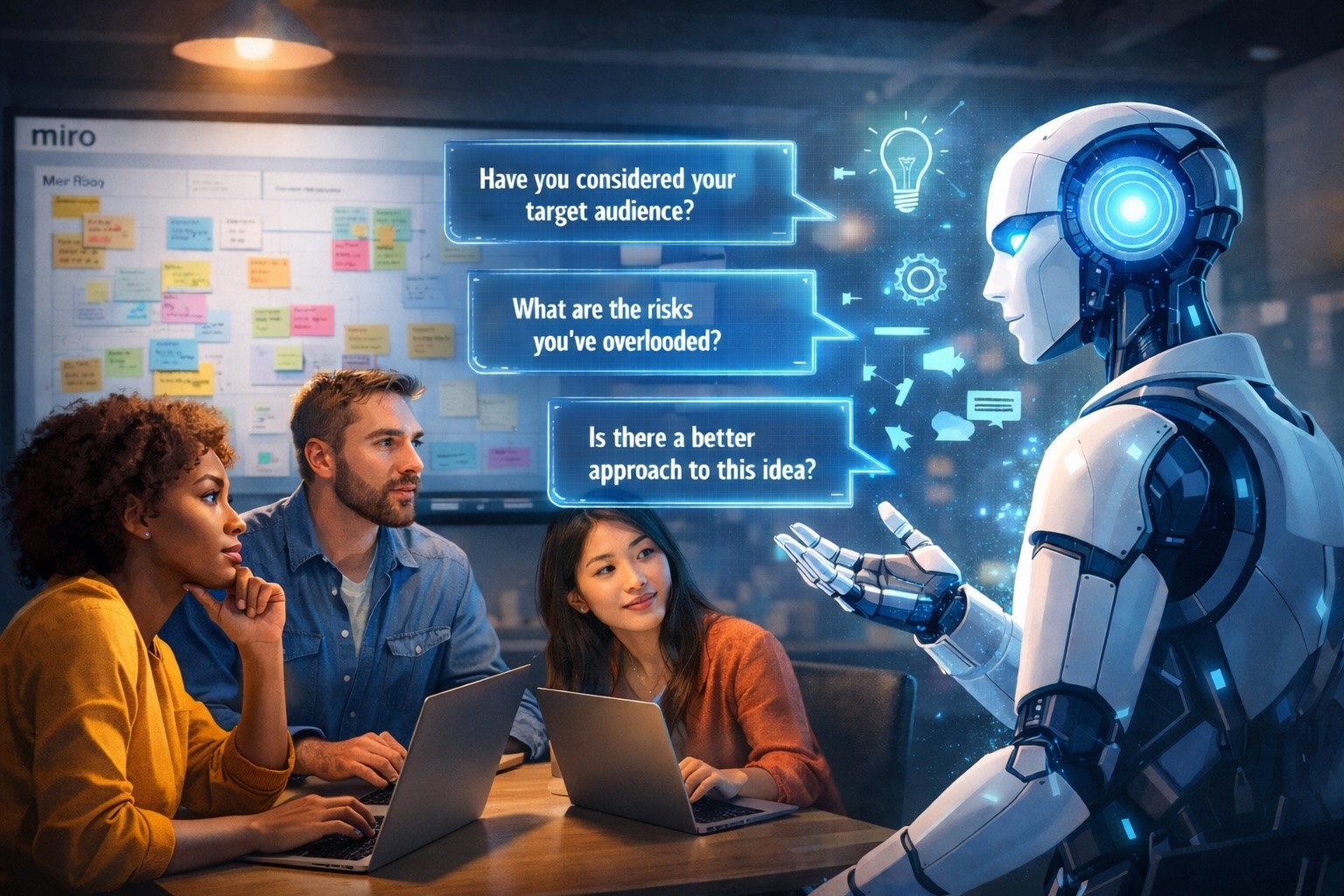
We'd been messing about with Miro's new AI capability, specifically what they call "Sidekicks" in our workshops. We made a shift that's subtle but ended up being significant. Instead of teams asking AI to generate ideas or summarise and document what they'd done, we started configuring Sidekicks to do something different and challenge the team back.
Picture this. A team is mapping out their product strategy. They've been at it for ninety minutes and they're getting comfortable with their assumptions. Then the Sidekick drops a question:
"You've mentioned 'customer experience' twelve times but haven't defined which customers you mean. Who specifically are you designing for and who have you decided to exclude?"
To begin with we get silence and nervous "how did we miss that" laughter. Then, the actual conversation begins and the AI challenge to the group works its magic.
This isn't how most people think about AI in collaboration. The default mode is AI-as-assistant. You give it a task, twiddle your thumbs while it does its thing, get an output. All very fast, efficient and pretty scalable at a personal level. But in a room full of people trying to solve a strategic problem, speed isn't the bottleneck, clarity and confidence are. The willingness to say the thing everyone's been dancing around.
And this is where an AI challenger becomes surprisingly useful.
A Miro AI Sidekick doesn't care about hierarchy. It won't soften its question because the boss is in the room. It has no career anxiety. It reads the Miro board as context, gets what's really going on or spots the glaring omission and asks the uncomfortable thing. Maybe it's the thing a junior team member might notice but would never say out loud, or something we miss while facilitating because they're we're focused on maintaining focus and keeping energy high.
Researchers at Carnegie Mellon have been exploring this exact dynamic, understanding how AI might serve in "partnership or facilitation roles rather than managerial ones." They describe AI as a tool that can provide the user with an alternative perspective. That's exactly what we're seeing. Not AI doing the thinking. AI provoking better thinking.
There's a reason this works particularly well in workshops.
When you're brainstorming alone with ChatGPT, the dynamic is simple. You prompt, it responds, you iterate, you share. But when you're in a room (or on a Miro board, or both) with a dozen other people, the social dynamics get complicated. Who speaks first? Who dominates? Who holds back? Now, our workshops go a long way to limiting this, nevertheless too often, the loudest voice often wins, not because their idea is best but because volume is a proxy for confidence.
AI can disrupt this in a useful way. When AI poses a question based on what the group have written on their stickies, not what someone said loudest, it creates a moment of democratic reckoning. Everyone has to engage with the same provocation and it pushes the collective to more and better ideas.
Being prompted" changes our role too.
Normally, a good facilitator reads the room, notices when things have gone off the boil and thinking is getting stale. They intervene with a question or activity to break the pattern and create progress. That skill still matters. But now you can configure an AI teammate to do some of that pattern-recognition work in real time. We can focus on human dynamics. The AI watches the content.
A piece from The Living Core, a German consultancy puts it nicely. Rather than letting AI do our work, we can create loops where AI prompts deeper exploration of our own ideas. They describe it as "positively disruptive prompting" or AI triggering thoughts we wouldn't have had otherwise.
That's the crux of it all. From AI as answer machine to AI as thinking partner. From prompting it to being prompted by it.
We're still in the early days of figuring this out, even the Miro AI Sidekicks are still in beta and the configurations that work best are still emerging. But we've seen enough to believe this is a meaningful direction.
In a world obsessed with AI outputs, the teams that will thrive are the ones who use AI to improve their inputs, the quality of their questions, the depth of their exploration, the honesty of their conversations.
Stop asking what AI can do for you. Start asking what AI can ask of you.
Next time: We'll look at an old role that's suddenly become essential, the editor. And why the skills it requires are important as they're hard to automate but harder to define than you'd think.