Working Jointly
The conversation is stuck on individual productivity. The harder question is what good teamwork looks like once humans and machines think together.
A new framework for collaboration in the AI era
Here’s a question no one’s asking clearly enough. What what actually happens to collaboration when AI shows up?
Not “how do I use ChatGPT better.” Not “will AI take my job.” The harder question. “When humans and machines start thinking together, what does good teamwork actually look like anymore?”.
We’ve spent the past year watching this play out. Working with teams, running workshops, watching what happens when AI gets dropped into existing ways of working. And we’ve come to believe that most organisations are solving the wrong problem.The conversation has been stuck on individual productivity. How do I get better at prompting? How do I save time? But the interesting challenge isn’t at an individual level, it’s what’s happening between people.
Here’s the pattern we keep seeing. AI doesn’t fix broken collaboration. It makes it worse. It amplifies the problems.
The loudest voice in the room used to dominate meetings. Now they dominate meetings and fire off polished looking documents before the rest of us have had time to think at all. Bad assumptions spread quicker. The same team dysfunctions that have always existed are now running at machine speed and with better formatting.
So what do most organisations do? They train people harder. More prompt workshops. More tool tutorials. More people getting clever with AI on their own.
Twenty people who are each good with AI doesn’t give you a team that’s good with AI. It gives you twenty separate experiments, twenty different approaches and confusion about which outputs to trust.
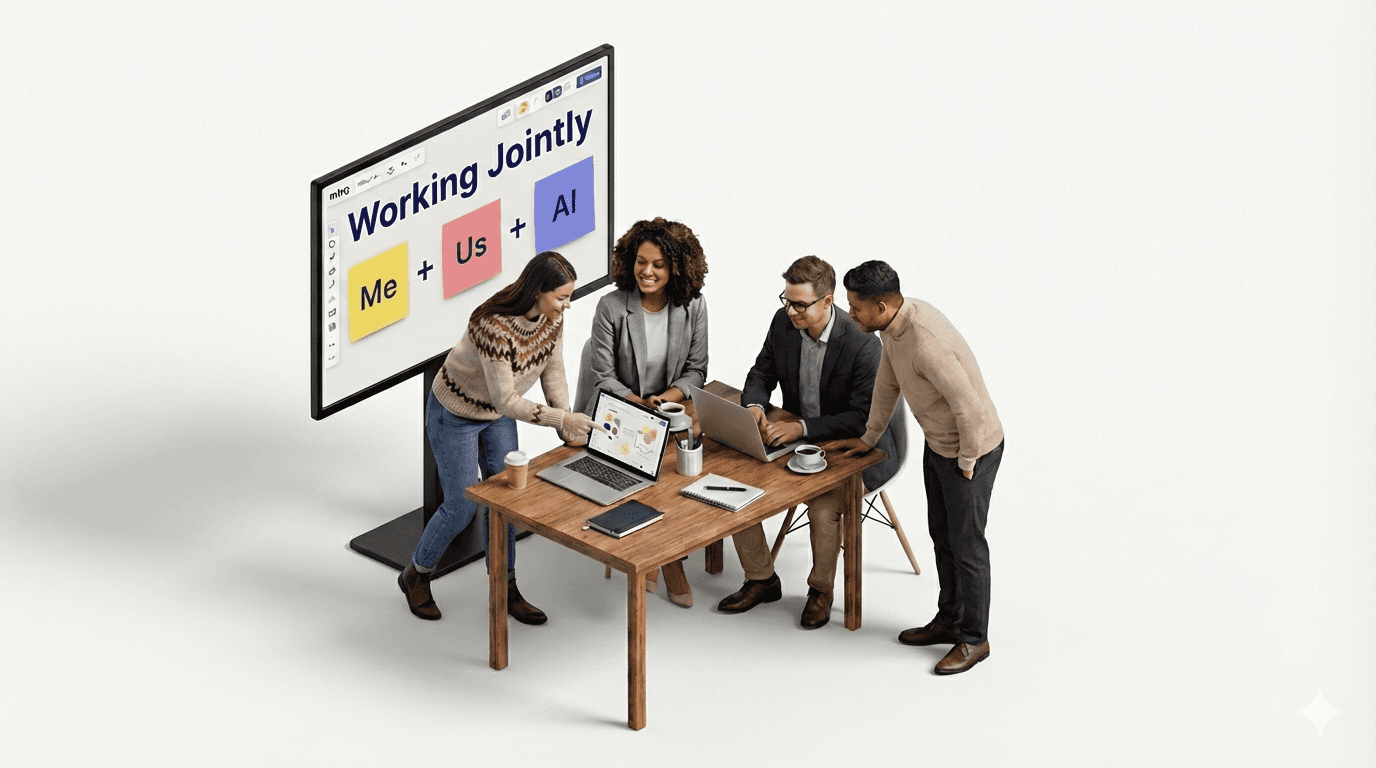
We’re proposing a framework that we’re calling Working Jointly. Not because we have all the answers, but because we need a name for the thing we’re trying to figure out. Three dimensions of joint work that we believe need to develop together. It goes something like this:
Me + AI
How I think, decide, and create alongside AI.
This is where all the attention goes, and fair enough, it’s where everyone has to start. Individual fluency with AI tools. You need individual fluency before anything else makes sense. You need to know when the thing is lying to you, when it’s useful, when it’s just making you lazy.
We should be honest here. This dimension has changed how we work. There are only a few of us. AI has let us operate like a company three times our size, creating, researching, prototyping at a pace that wasn’t possible before. We’ve learned a lot about what works, what doesn’t and where the traps are. It’s time we started sharing that.
Me + Us
How we collaborate better as humans.
This is home turf for us. It’s where Jointly started, years before anyone was talking about ChatGPT. We’ve spent a long time helping teams actually think together, using Miro, designing workshops, trying to create the conditions where a room full of smart people produces something smarter than any of them would alone. It’s harder than it looks. Most meetings fail at it.
Here’s what gets overlooked in the AI conversation. The human skills that matter more, not less, as AI handles more of the execution. How do we disagree productively? Make decisions under uncertainty? Hold each other accountable? Build trust?Teams with the strongest human collaboration will use AI best. This dimension is often the first casualty in the rush to adopt new tools. We think that’s a mistake.
Us + AI
How teams use AI collectively, not individually.
This is where almost no one is yet. Shared prompts. Shared workflows. Shared practices. Intelligence that compounds across a team over time, not just within individual heads.
Everyone is training individuals. Almost no one is building organisational AI capability. That gap—between individual fluency and collective intelligence—is where we think the real opportunity lives.
AI amplifies existing dynamics. If your collaboration is weak, AI makes it weaker. If it's strong, AI becomes an accelerant.
The argument we're making is this:
The organisations that get this right won’t treat Me, Us, and AI as three separate problems, an AI training initiative here, a culture programme there, some team-building off to the side. They’ll see them as three dimensions of the same thing. A way of working where AI amplifies what teams can do together, and where the human collaboration actually gets better rather than being hollowed out.
What comes next
We're going to work through this, in public. What we’re learning, what we’re getting wrong, what we’re stealing from people smarter than us. We’ll share the practices that seem to help and the experiments that fell flat. There’s no playbook for this yet. We’re writing it as we go, and we’d rather do that out loud than pretend we’ve got it figured out.